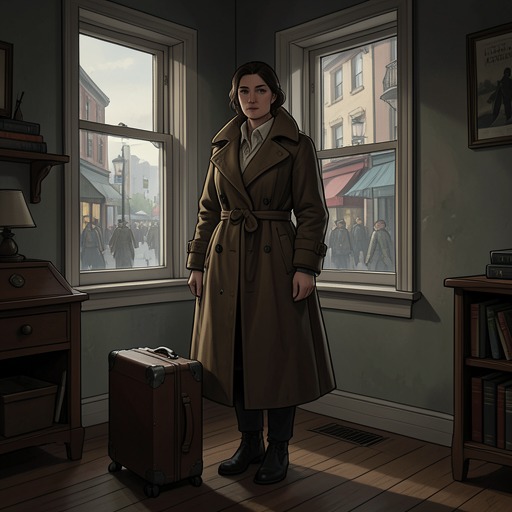
Giuseppina’s displacement from Bagnara
The Florios of SicilyGiuseppina’s displacement from Bagnara is not simply a change of residence but a lasting separation from her home, kin, and sense of choice. In Palermo, memories of the place she left return alongside the knowledge that her life was arranged by others: she has been uprooted, and the new city does not erase the constraints of her marriage or the losses that preceded it.
Bagnara and the separation
The move leaves Giuseppina looking back toward Bagnara even after she has arrived in Palermo. As Paolo and Ignazio attend to the new city, she keeps her eyes on the open sea as though she can still see the place she has left. A tear falls on her shawl as she recalls the trees reaching toward the water, the streets she ran through, and the pier beneath King Roger’s Tower. These remembered details give her former home a particular shape: it is not an abstract past, but a landscape of routes, shore, and familiar company.
Mattia is central to that remembered world. More than a sister-in-law, she had been Giuseppina’s friend and support during the difficult first months of her marriage to Paolo. At their farewell on the pier, Mattia kissed her cheek, promised that they would exchange letters, and urged her not to think herself alone. Giuseppina protested that the separation was unfair and that she did not want it. Mattia answered that women were their husbands’ property and had little power, telling her to be strong. The exchange makes the move personal as well as social: Giuseppina loses daily closeness to the person who had helped her endure her marriage, while both women understand that their choices are circumscribed by their husbands.
The separation is not presented as a journey Giuseppina freely undertakes. Paolo Barbaro remains in Bagnara, intending to travel back and forth to Palermo for trade and to maintain another safe harbor. He says that he needs a woman to look after his house and children. Giuseppina suspects that he also wants to keep Mattia away from her brothers, particularly from Ignazio, whose bond with Mattia Paolo dislikes. Her hope that Mattia and Paolo Barbaro might follow the family to Palermo is soon extinguished. The household’s relocation therefore divides relationships instead of bringing the family together.
Arrival in Palermo
The new city offers a sharp contrast to the home Giuseppina remembers. After Paolo and Barbaro stay behind to unload their merchandise, Emiddio leads Giuseppina and Ignazio through Porta Calcina. Palermo’s streets pass between shops and warehouses and alongside poor, cramped-looking houses. Giuseppina recognizes some faces but does not answer their greetings. Her silence and shame show that arrival has not given her an immediate place in the city; she is physically present but emotionally withdrawn.
Vittoria’s response to the move is different. The girl laughs and pirouettes as she walks, imagining a future in which she is no longer an orphan taken in out of charity and might have money, a husband who is not a relative, and greater freedom than she could expect in her village between mountains and sea. Giuseppina sees the contrast with resentment: Vittoria, having had little, has little to lose, while the move seems to offer her something. Giuseppina, by contrast, feels destitute and unmoored. The same change of place can look like possibility to the child and dispossession to the woman who remembers what she has left behind.
Constraint, marriage, and grief
Giuseppina’s sense of displacement is reinforced by the gendered limits Mattia names at their farewell. Wives are treated as their husbands’ property, and men make the decisions; Giuseppina’s own experience of marriage gives that statement force. The narration notes that husbands may not know how to treat their wives, and identifies Paolo as such a husband. Her removal from Bagnara thus compounds an existing loss of agency: she has been separated from her familiar home and friend without being able to decide whether she will go.
Later, when Paolo is dying, Giuseppina again measures the present against the life she might have had. She tells Mattia that if they had stayed in Bagnara, this would not have happened. Mattia cautions that no one can know what lay ahead: their husbands might have been shipwrecked, or another earthquake might have occurred. She speaks from her own experience of leaving her family because her husband fell ill, and of becoming estranged from her brother as a result. The women’s exchange does not settle what the move caused; instead, it exposes the painful uncertainty behind Giuseppina’s counterfactual, as well as the repeated way marriage and illness can separate women from their kin.
Giuseppina’s claim that she has nobody is contradicted, but not simply dismissed, by the relationships still around her. Mattia reminds her that she has her beautiful son and Ignazio, who is her blood. The reassurance offers a connection within the life she now inhabits, yet it cannot restore the relatives she has lost or undo her separation from Bagnara. Giuseppina’s distress is bound to both the people who remain and the people and places she cannot recover.
Memory and continuing displacement
The narrative returns to the move through small, recurring signs of unease. When Giuseppina shuts the door after Paolo has been outside, she wonders where he is going and feels a weight on her chest. The scene does not explain that feeling as homesickness alone; it places her unease within her strained life with Paolo and the precariousness of the household. Her displacement is therefore an ongoing condition, not a single departure whose effects end at arrival.
The memory of Bagnara also returns through the open sea and through the people associated with the old home. A later reminder of childhood food links a present domestic scene with remembered life in the Florio household, showing how ordinary objects can reopen earlier memory. These returns do not restore the past. They make visible the distance between a remembered home, the constrained present, and the uncertain future.
Significance
Giuseppina’s experience gives the family’s relocation a human cost distinct from its commercial context. The movement to Palermo belongs to a world of ports and trade, but her story registers what such mobility can demand from someone who does not control it: separation from a friend, shame and disorientation in the destination, and the continued burden of a marriage lived without the freedom to choose her circumstances. Her contrast with Vittoria further shows that displacement has no single meaning; the prospect of a new life can be hopeful for one person and devastating for another.
Bagnara remains present not as a place Giuseppina can return to in the evidence, but as a remembered landscape and network of affection against which Palermo is measured. Mattia’s farewell, her later counsel, and Giuseppina’s grief during Paolo’s illness reveal the persistence of bonds across distance while also marking what distance cannot mend. The move’s significance lies in that unresolved tension: Giuseppina builds a life in Palermo, but the loss of home and choice continues to shape how she understands it.